Aurora Flight Sciences (A Boeing Company)
Overview
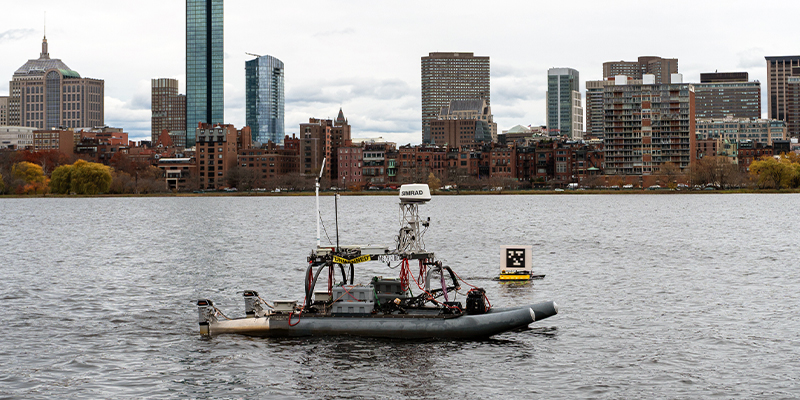
Header photo: Aurora Flight Sciences, from their February 2026 announcement of this same FALCON demonstration.
I spent the summer on Aurora Flight Sciences’ Autonomy Division (AI/ML Group), working on FALCON — an adaptive control framework developed under the DARPA LINC program in collaboration with MIT’s Aerospace Controls Lab (Prof. Jonathan How, Kresa Center for Autonomous Systems). FALCON systems handle unpredicted runtime events — currents, motor disturbances, unmodeled disturbances — without relying on the operator to intervene.
The internship’s central question: can FALCON be rapidly deployed across different vehicle platforms? My focus was quadrotors — porting and extending FALCON’s adaptive controllers from Aurora’s existing boat platforms onto a PX4-based quadcopter stack, then proving it out both in simulation and on real hardware.
By the end of the summer, this work included a swappable rate-controller library running on real hardware, an adaptive observer-based controller (AAOBLTR) tuned and flying, analytical control barrier functions for safe guidance, and a live flight demonstration for DARPA.
| Workstream | Summary | Status |
|---|---|---|
| PX4 Debugging | Diagnosed and resolved an issue in the prior figure-8 implementation | ✅ Fixed |
| Analyzation Tooling | Built Foxglove tools; iterated RViz → full 3D replay | ✅ Complete |
| Controller Library | Implemented PID, RSLQR, OBLTR, AAOBLTR behind a swappable interface | ✅ Flying on HW |
| AAOBLTR Tuning | Tuned the adaptive observer-based controller | ✅ Stable flight |
| DARPA Demo | Live demonstration of AAOBLTR | ✅ July 22 |
| CBF Obstacle Avoidance | Closed-form safety filter, validated in simulation | ⚠️ Sim only — HW blocked |
| HLOC Perception | Improved boat detection / pose estimation pipeline | ✅ Accuracy improved |
Debugging the Existing FALCON Pipeline
Before extending anything, I had to get the existing figure-8 mission implementation working again — diagnosing and fixing a bug in the prior team’s PX4 integration. This became the regression baseline for everything that followed.
Foxglove Analyzation Tooling
Understanding why a controller misbehaves on real hardware requires seeing the data, not just the numbers. I built a series of Foxglove-based analysis tools, iterating from a raw 2D trajectory plot up to a full synchronized 3D replay with per-axis torque and rate-error traces.
This tooling became essential for every later stage of the internship — tuning controllers, debugging hardware discrepancies, and preparing the DARPA demo all depended on being able to quickly see what the vehicle actually did versus what it was commanded to do.
Custom Rate Controller Library in PX4
FALCON’s adaptive controllers needed to live inside PX4’s angular rate control loop (250 Hz, body frame) — the innermost, highest-rate loop in the cascaded position → velocity → attitude → rate control architecture.
I designed a runtime-swappable rate controller library so PID, RSLQR, OBLTR, and AAOBLTR could all sit behind a common interface and be selected — even mid-flight, in the field — via a custom QGroundControl parameter, without needing a firmware reflash.
This meant new uORB message types to carry controller-specific telemetry, and QGC UI extensions to expose the new tuning fields alongside PX4’s stock PID parameters.
Adaptive Observer-Based Control (OBLTR / AAOBLTR)
The core controller I tuned and flew was AAOBLTR — Adaptive Augmented Observer-Based Control with Loop Transfer Recovery:
- OBLTR estimates states the vehicle can’t directly sense (due to noise or missing sensors) and flies as if every state were known.
- AAOBLTR builds on this with an online self-adjusting observer that converges back to its designed transient performance even as conditions change.
After tuning, the estimated and real states converged to near-zero error, and roll/pitch/yaw rate tracking held up well across a full flight. The controller flew a full figure-8 mission on hardware in MIT’s netted flight-test cage.
Analytical Control Barrier Functions for Safe Guidance
Beyond tracking, I designed and implemented closed-form control barrier functions (CBFs) to give theoretically guaranteed collision-free guidance — no online quadratic program required. For a single active spherical obstacle, the safety-filtering problem reduces to one linear inequality with a closed-form projection back onto the safe set.
The filter was validated in simulation against a figure-8 mission with an obstacle placed directly in the flight path — the CBF-filtered trajectory consistently stayed outside the obstacle’s safety radius while the unfiltered path did not.
Getting this onto hardware hit a wall: a ROS2 namespace issue — caused by custom MIT-lab-specific settings — blocked goal/CBF message delivery, so the algorithm never got validated in flight.
Takeaway: simulation-only validation isn’t enough for safety-critical guidance logic — the team needs a more robust hardware-in-the-loop (HITL) pipeline so integration issues like this surface before, not during, flight testing.
Perception: Hierarchical Localization Stack (HLOC)
In parallel, I contributed to Aurora’s vision-based pose estimation pipeline for boats — used when GPS and AprilTag fiducials aren’t available. I improved the HLOC perception stack by applying masking to observed features and swapping in an off-the-shelf YOLOv11n detector.
The result: 2x the detected throughput, a ~10% improvement in x-axis position accuracy, and a ~2% improvement in heading — traded off against a ~15% degradation in y-axis accuracy, a tradeoff worth revisiting with further tuning.
Live DARPA Demonstration
On July 22nd, I gave a live demonstration of the AAOBLTR controller flying on the quadrotor platform for DARPA — the culmination of the controller library, tuning, and tooling work from the rest of the summer.
Aurora publicly announced FALCON’s earlier surface-vessel results under this same DARPA LINC program in February 2026 — AI-guided control held vehicles in a safe operating zone 94% of the time versus 63% under manual control, and cut hazard-recovery time by 61%. My work extended that same FALCON architecture from boats to quadrotors.
Lessons Learned
Technical
- Hardware testing is hard — HITL validation matters as much as SITL, and reusable launch tooling pays for itself in saved setup time.
- Advanced controllers (OBLTR, AAOBLTR) have a steep ramp-up; analysis tooling (Foxglove, RViz replay) is what makes that ramp-up tractable.
Professional
- First real experience working against hard, externally-imposed deadlines (the DARPA demo date).
- Working on a fast-paced, experienced team raised the bar for how I scope and communicate progress.
People & Culture
- In-office connections mattered more than expected for unblocking work quickly.
- A strong team culture measurably boosted productivity.
Summary of Contributions
- Extended FALCON controllers and associated missions to quadrotors — RSLQR, OBLTR, and AAOBLTR running on PX4 firmware.
- Designed and implemented analytical CBFs for theoretically guaranteed safe guidance (obstacle avoidance).
- Delivered a live DARPA demonstration of FALCON controllers on an aerial platform.